Last year I wrote about a small exhibition of lithographs 150 Years of Languedoc grape varieties. One variety I highlighted was Aspiran Noir and commented that Domaine Thierry Navarre at Roquebrun had rescued and grafted some vines and is now making wine from them. By chance the caviste at Les Caves Gourmandes in Gignac recommended a bottle that turned out to be Thierry's Rybeyrenc - yet another synonym/spelling variation for the variety.
Rybeyrenc 2011 has an attractive red colour, quite light for a Languedoc, and a distinct aroma of strawberry and mulberry. The palate is light and refreshing, a delight to just drink and at 11 deg. is a shock to one accustomed to southern reds. The closest in style would perhaps be a basic vrac red from a co-op petrol pump, but in this case the wine has the rustic edges and other dodgy characteristics eliminated and a lot more interest.
I've tried a couple of other of Thierry Navarre's wines recently. Le Laouzil 2010, a classic red blend enjoyed at the superb Octopus restaurant in Béziers where it's listed with a very modest mark-up. Ideal luncheon fayre, it also danced around a bit en bouche - the only clue that many would classify it as vin naturel.
Cuvée Olivier 2011 is also an appellation blend and is a fuller, slightly richer style with wonderful poise and balance. Apparently aged in 500 litre barrels, but clearly these are not new as the oak is not really noticeable which is the way I like it. Feels like a wine that will keep for a few years yet also drink well throughout its life.
Prices seem reasonable and range from €8 to €13 for the Olivier. Must get over there.
Wednesday, 15 May 2013
Saturday, 27 April 2013
Sunday lunch at Domaine des Agriolles
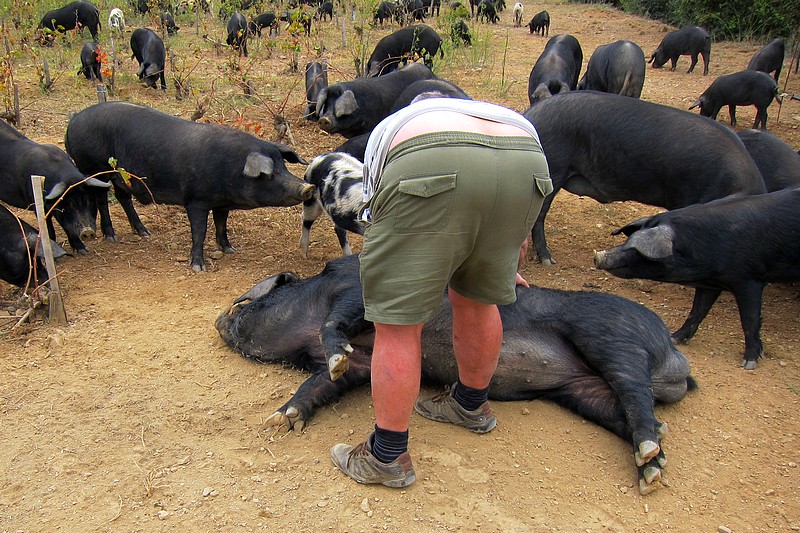
Domaine des Agriolles don't make wine, it's a Ferme des Cochons (Pig farm, although that just doesn't have the same ring to it). Lunch and entertainment was the centrepiece on their popular open day.
On the wine front it was BYO to accompany the fine - for mass outdoor catering - lunch. In our group I was reminded how racy and stimulating Muscadet can be, too good to be mixed with cassis as a kir. On the other hand a magnum of 2005 claret from somewhere in the Haut Medoc didn't inspire me; chunky and too firm.
We brought a bottle of 2012 SansSoo Domaine de la Réserve d'O from Arboras/St Saturnin (i.e. Terrasses du Larzac). A blend of Syrah and roughly a third Cinsault there is no added sulphur, hence the pun. Initially there was heaps of sweet straightforward red fruit that took a while to calm down; maceration carbonique was suggested. Attractive drinking but not as serious as the ridiculously thick heavy glass bottle might suggest. Well made and certainly won't upset those wary of the wilder styles of unsulphured wine. I suspect this was recently bottled and should improve as the elements settle down.
The Domaine des Agriolles is not far from the A750 west of Montpellier and has an attached shop Boutique Ô champs where the deep flavoured pâté included in the lunch can be purchased, along with plenty of other pork products and more. The cochons are raised on an artisan scale with unrestricted access to plenty of outside space. Everything is processed on site. Most of the produce is sold locally to those in the know.
On the wine front it was BYO to accompany the fine - for mass outdoor catering - lunch. In our group I was reminded how racy and stimulating Muscadet can be, too good to be mixed with cassis as a kir. On the other hand a magnum of 2005 claret from somewhere in the Haut Medoc didn't inspire me; chunky and too firm.
We brought a bottle of 2012 SansSoo Domaine de la Réserve d'O from Arboras/St Saturnin (i.e. Terrasses du Larzac). A blend of Syrah and roughly a third Cinsault there is no added sulphur, hence the pun. Initially there was heaps of sweet straightforward red fruit that took a while to calm down; maceration carbonique was suggested. Attractive drinking but not as serious as the ridiculously thick heavy glass bottle might suggest. Well made and certainly won't upset those wary of the wilder styles of unsulphured wine. I suspect this was recently bottled and should improve as the elements settle down.
The Domaine des Agriolles is not far from the A750 west of Montpellier and has an attached shop Boutique Ô champs where the deep flavoured pâté included in the lunch can be purchased, along with plenty of other pork products and more. The cochons are raised on an artisan scale with unrestricted access to plenty of outside space. Everything is processed on site. Most of the produce is sold locally to those in the know.
Labels:
Reserve d'O
Monday, 22 April 2013
En retard
Northern Europe experienced the coldest March ever recorded in places with the meteorological finger pointed firmly at the jet steam which was sitting further south than "normal" for early spring. The consequence of this in the Languedoc has been a wet March, certainly the wettest for more than 50 years and near the Pic Saint-Loup all records were broken with 357mm for the month (or pushing half and inch a day if you prefer).
Given there were relatively few damaging floods this is mostly good news as the water table is now back to "normal" after a run of too many relatively dry winters. Ditches have flowing water and the countryside looks greener for it, as do weed killer free vineyards.
An asparagus grower in the village told me the season started a month late, although a mid-March start would have been considered a bit prompt. Cold nights are blamed with the inability of the skies to string together more than a day of sun. In the photo above, taken on the 11th April, the vines are visually dormant. A week of sunshine from 12th has done the trick and bud-burst in under way.
Given a "normal" summer, no doubt the least likely scenario, the harvest is going to be a couple of weeks late. At least the drier vineyards will be sparing established vines water stress.
Given there were relatively few damaging floods this is mostly good news as the water table is now back to "normal" after a run of too many relatively dry winters. Ditches have flowing water and the countryside looks greener for it, as do weed killer free vineyards.
![]() |
| Weed killer free vineyard enjoys a wet 2013 spring |
![]() |
| Old Cinsault vine bud-burst 22nd April 2013 |
Labels:
Aspiran,
Climate change
Friday, 5 April 2013
Climate change
My post on "Freshness" in wine reminded me about climate change and specifically evidence for it. The Observatoire Viticol site for the Department de l'Herault is an excellent source of all sorts of statistics related to matters vinous. Original material can be reproduced providing credit is given.
The following chart is from the 'Documents' section under 'Viticulture' sub-menu 'Milieu Physique' and uses data from Meteo France. It plots the average annual temperature over 62 years in Montpellier.
Clearly the 1980s saw a transition and since then the average temperature has risen by pushing one degree C in relation to the long-term average since 1950. 1987 is the most recent below average year, although 2010 got close mainly due to a cool summer.
Further analysis of this quickly becomes subsumed into other variables, a reminder that statistics can be used to prove anything. This chart plots average winter temperatures with the interesting observation being that colder winters tend to come in 3 year clutches.
Other charts show that most of the warming since the 1980s is down to warmer May to August weather. This fits in with the winter temperatures chart above, along with 2010 having a cooler summer than recent years resulting in a lower average temperature than its peers.
I found some Eurostat and DataMarket data on Languedoc-Roussillon Degree-Days from 1980 to 2009. Degree-days are used as a guide to how much heating a house will need, so the lower the figure the warmer it is. On days when the temperature exceeds 18 deg. C that day scores zero. Below that, the colder it is the bigger the number so the data is more a measure of winter temperature than summer highs.
As expected, Degree-Days shows a correlation with the average winter temperatures chart above. What my chart displays is the moving average (purple line) which is clearly in decline.
When it comes to wine then cooler nights in the growing and especially ripening season will normally be more desirable for growers than the absolute average temperature.
I also looked at rainfall data for the Hérault. Because of the mountainous hinterland rainfall amounts vary dramatically but one conclusion that can be drawn is that since 1999 below average winter rainfall featured in the majority of years, especially on the coastal plains. Most climatologists seem to agree that we must expect more weather extremes going forward. March 2013 has been the wettest since 1960 in most places (Montpellier had 191 mm) and in some areas, e.g. close to Pic St Loup, the wettest on record. On a positive note the water table, having been in decline due to too many dry winters, has recovered and is good news for most vineyards.
The following chart is from the 'Documents' section under 'Viticulture' sub-menu 'Milieu Physique' and uses data from Meteo France. It plots the average annual temperature over 62 years in Montpellier.
Clearly the 1980s saw a transition and since then the average temperature has risen by pushing one degree C in relation to the long-term average since 1950. 1987 is the most recent below average year, although 2010 got close mainly due to a cool summer.
Further analysis of this quickly becomes subsumed into other variables, a reminder that statistics can be used to prove anything. This chart plots average winter temperatures with the interesting observation being that colder winters tend to come in 3 year clutches.
Other charts show that most of the warming since the 1980s is down to warmer May to August weather. This fits in with the winter temperatures chart above, along with 2010 having a cooler summer than recent years resulting in a lower average temperature than its peers.
I found some Eurostat and DataMarket data on Languedoc-Roussillon Degree-Days from 1980 to 2009. Degree-days are used as a guide to how much heating a house will need, so the lower the figure the warmer it is. On days when the temperature exceeds 18 deg. C that day scores zero. Below that, the colder it is the bigger the number so the data is more a measure of winter temperature than summer highs.
As expected, Degree-Days shows a correlation with the average winter temperatures chart above. What my chart displays is the moving average (purple line) which is clearly in decline.
When it comes to wine then cooler nights in the growing and especially ripening season will normally be more desirable for growers than the absolute average temperature.
I also looked at rainfall data for the Hérault. Because of the mountainous hinterland rainfall amounts vary dramatically but one conclusion that can be drawn is that since 1999 below average winter rainfall featured in the majority of years, especially on the coastal plains. Most climatologists seem to agree that we must expect more weather extremes going forward. March 2013 has been the wettest since 1960 in most places (Montpellier had 191 mm) and in some areas, e.g. close to Pic St Loup, the wettest on record. On a positive note the water table, having been in decline due to too many dry winters, has recovered and is good news for most vineyards.
Labels:
Climate change
Sunday, 3 March 2013
Saint-Chinian Tasting
The characterful Maison de la Région Languedoc Rousillon in London hosted a tasting of Saint-Chinian producers to brighten up yet another grey weather day. Such a relatively specialised tasting is a brave but admirable move, but given the variety of terroirs the geology has endowed on the land a shrewd choice.
13 growers were billed, but I'd heard of less than half and tasted even fewer. The only no-show was Domaine Rimbert who make the wines I'm most familiar with, so unfortunately I lost a quality reference point. There was however the Cave Les vins de Roquebrun, the highest quality co-op I've come across in the whole of the Languedoc. They weren't showing the Terrasses de Maynard cuvée I wrote up, but their reds were solid performers although lacked the life and expression I found in most of the independents.
Saint-Chinian has slate (schist) soils to the north-east where it borders Faugères with the remainder mainly clay and limestone (argile calcaire) along with pockets of red sandstone (grès) and more schist. The majority of growers have parcels in several terroirs and either bottle them separately or blend them.
On this occasion there were no prices on display, something I welcomed as it removed a distraction from my on the day assessment. Subsequent research indicates the majority of the wines retail in France in roughly the €7 to €14 euro bracket. Relatively few are regularly imported into the UK, obviously one of the reasons for the event.
Domaine Boissezon Guiraud was the stand-out example of an estate expressing the different terroirs with their vineyards widely spread but still mainly schist sites. All the reds are un-oaked. Comme à Cayenne 2011 (mainly grenache with some carignan) has black fruits with hints of liquorice. Suite dans les idées 2011 (2/3 mouvèdre with syrah and carignan) is a bit more medicinal in a nice way with some sour plum. Temps des Cerises 2011 (half syrah) really did have fresh light fruits and a leather with cherry stone palate. Finally Terre Promise 2010 (2/3 syrah 1/3 carignan) had sweaty leathers, pepper and is a bit more baked but certainly not overdone.
Those I chatted to about the tasting afterwards praised Domaine La Madura. I enjoyed the Classic classic 2009 (carignan, grenache with some syrah and mouvèdre). A fine example of the blending of terroirs to make things more complex. Lovely texture and balance with a blackberry and savoury character.
I first came across Château de Combebelle just over two years previously in the same salon at the superb Outsiders tasting. This time Catherine Wallace was showing three vintages (2009, 20010 and 2011) of her 60% syrah 40% syrah appellation conforming reds. I particularly liked the open full of life style of the 2010 that jumps around. The 2009 has more noticeable chewy savour tannins. The 2011 needs a while to integrate and seems like it will fall between the two styles.
Clos Bagatelle has a catchy name hence I recall coming across it over the years, no doubt as the estate can be traced back to 1623 apparently. The Donnadieu Mathieu Marie 2010 (1/2 syrah with mouvèdre, grenache and carignan) had a nice floral red fruits perfume and made for delicious uncomplicated drinking. Apparently the 2006 won a Decanter medal so one would expect the wine to show well in this environment.
The tasting was about reds as befits the region. Of the whites, I found the Mas Champart Blanc 2011 (Marsanne, Roussanne, Bourboulenc, Grenache and from the "odds and ends" table of bottles) the most interesting. Lovely balance and structure, not too much oak, crushed fennel freshness and the most complex white I tasted. I also liked Château Bousquette Nord et Sud 2011 2/3 vermentino1/3 viognier. Perhaps a bit prickly for being harvested promptly, but nice citrus character with the viognier perfumes restrained in the background. Also worth a mention is the Domaine La Madura Classic blanc 2011 100% sauvignon blanc and unoaked (the Grand Cru blanc is oaked). Clean, nice and grassy with a good body.
Conclusions -
- Plenty of interesting and good drinking wines were on show.
- Excellent value on offer, especially at the lower price levels when compared to some of the more fashionable areas such as the Terrasses du Larzac.
- Syrah seems to do particularly well in many sites. The volume seems to be turned down and it comes across as being more subtle and less of a bully in blends.
- I'm not convinced by many of the oaked reds - most growers offered both oaked and unoaked styles. Too many seemed flatter and less expressive when compared to their "simpler" un-oaked siblings. I prefer oak you don't notice and can "see" through; the trio from Château de Combebelle being a fine example of how to get it right.
Labels:
Saint-Chinian
Sunday, 17 February 2013
Freshness and minerality
A good chunk of my career was spent (trying to) put a simple structure on the design of IT systems - eliminating complexity and keeping things simple. That style of analysis doesn't go very far with wine and the Languedoc in particular; plenty of examples break any generalisations or hypotheses. For instance, interesting wines can be made from cold loving northern grape varieties and plenty of wines defy the style of a vintage or age well beyond all expectations. However, I have observed considerable consensus on what most wine makers are striving for these days and a single word sums it up; freshness (fraîcheur).
Freshness in a wine is principally an attractive acidity and an impact the equivalent of crushing wild fennel stalks, but there's more to it, especially with red wine. The tannins have to be just ripe and along with sugar levels must keep the resulting (usually high) alcohol level in balance. What one could coin "old school" Languedoc is the opposite - baked over ripe tannins with no grip and flabby low acidity (not to mention any rustic qualities). The trick seems to require even ripening in the vineyard backed up with picking at the right time and combined with great care in the winery over things like fermentation temperature, exposure to air and the use of oak.
With white wines the equivalent holy grail is minerality, although not all wine styles strive for it. I find minerality tricky to explain and means different things to different tasters as minerals don't really have a taste plus there's no evidence that vines extract mineral tastes from the soil. For me it's a bit like the initial sensation of licking a pebble from a mountain stream but more pleasant. In wine, proper Chablis has minerality in spades. Back in the Languedoc I find it more noticeable in the less aromatic heat loving grape varieties - Terret, Grenache Blanc, Vermentino, Carignan Blanc and the like.
Freshness in a wine is principally an attractive acidity and an impact the equivalent of crushing wild fennel stalks, but there's more to it, especially with red wine. The tannins have to be just ripe and along with sugar levels must keep the resulting (usually high) alcohol level in balance. What one could coin "old school" Languedoc is the opposite - baked over ripe tannins with no grip and flabby low acidity (not to mention any rustic qualities). The trick seems to require even ripening in the vineyard backed up with picking at the right time and combined with great care in the winery over things like fermentation temperature, exposure to air and the use of oak.
With white wines the equivalent holy grail is minerality, although not all wine styles strive for it. I find minerality tricky to explain and means different things to different tasters as minerals don't really have a taste plus there's no evidence that vines extract mineral tastes from the soil. For me it's a bit like the initial sensation of licking a pebble from a mountain stream but more pleasant. In wine, proper Chablis has minerality in spades. Back in the Languedoc I find it more noticeable in the less aromatic heat loving grape varieties - Terret, Grenache Blanc, Vermentino, Carignan Blanc and the like.
![]() |
| Vines on Basalt terroir - said to give freshness to wines but there seems to be little real evidence |
Labels:
Freshness and Minerality
Saturday, 2 February 2013
A like minded lunch
Tom Cannavan's excellent wine-pages site and forum have dedicated members (forumites) who organise regular informal BYO restaurant meals in London and the UK. One annual theme is "Less Celebrated France" which basically bypasses Bordeaux, Burgundy and the Rhone, and usually has good Languedoc-Roussillon representation.
We are fortunate to be hosted by one of London's finest restaurants The Ledbury. This was the menu and line up for my table. Wines are submitted by participants and the Ledbury team devise dishes to match.
Nobody was taking notes, everyone wanted to focus on the occasion and the company. The most complex wines were the pair of Coulée de Serrants. They had been double decanted the day before and each taste was like opening a new window on an Advent calender. Very much wine lovers' wines and fine accompaniments to the rabbit boudin with pumpkin soup with thyme foam (picture below). The Languedoc 1998 Marfée Les Champs Murmurés has aged magnificently, although it wasn't an ideal match for the dish. Later vintages (the Domaine only started in 1997) seem more expressive with better integrated tannins - I've been enjoying the 2000 and 2001 over the winter, but have yet to try a younger vintage.
The trio of reds were perfect with the deep flavoured lamb. The 2001 Terrasse d'Elise cuvée Elise (Syrah, Grenache and Mourvèdre and essentially a Terrasses du Larzac) was understated, subtle with quite gentle perfume and nice ripe fruit that avoided being jammy. Yes it was the wine I contributed, but the table concurred all three were a success. Of the Tempier Bandols I preferred the more elegant 2002 La Migoua, but that could change if I were to taste the pair in 5+ years time when the 2001 may have developed further.
Note that I posted on a range of Terrasse d'Elise wines hosted by Xavier Braujou in Montpeyroux back in 2009 here.
The third wine from the region was 1998 Domaine de la Rectorie Banyuls Cuvée Léon Parcé. Tawny port like and immensely satisfying, perfect with the Frangipane "cake".
Three final words - a real treat.
We are fortunate to be hosted by one of London's finest restaurants The Ledbury. This was the menu and line up for my table. Wines are submitted by participants and the Ledbury team devise dishes to match.
Nobody was taking notes, everyone wanted to focus on the occasion and the company. The most complex wines were the pair of Coulée de Serrants. They had been double decanted the day before and each taste was like opening a new window on an Advent calender. Very much wine lovers' wines and fine accompaniments to the rabbit boudin with pumpkin soup with thyme foam (picture below). The Languedoc 1998 Marfée Les Champs Murmurés has aged magnificently, although it wasn't an ideal match for the dish. Later vintages (the Domaine only started in 1997) seem more expressive with better integrated tannins - I've been enjoying the 2000 and 2001 over the winter, but have yet to try a younger vintage.
The trio of reds were perfect with the deep flavoured lamb. The 2001 Terrasse d'Elise cuvée Elise (Syrah, Grenache and Mourvèdre and essentially a Terrasses du Larzac) was understated, subtle with quite gentle perfume and nice ripe fruit that avoided being jammy. Yes it was the wine I contributed, but the table concurred all three were a success. Of the Tempier Bandols I preferred the more elegant 2002 La Migoua, but that could change if I were to taste the pair in 5+ years time when the 2001 may have developed further.
Note that I posted on a range of Terrasse d'Elise wines hosted by Xavier Braujou in Montpeyroux back in 2009 here.
The third wine from the region was 1998 Domaine de la Rectorie Banyuls Cuvée Léon Parcé. Tawny port like and immensely satisfying, perfect with the Frangipane "cake".
Three final words - a real treat.
Labels:
Restaurants,
Terrasse d'Elise
Subscribe to:
Posts (Atom)